Consensis in 40 seconds
How the spec tables in a catalogue become data — and which cells still need a human eye.
Document extraction API · built for correctness
One wrong number means the wrong part ordered, a design that doesn't fit, a quote that's off. So we never trust a single reading: every value is read several independent ways and only counts as verified when the readings agree. Every cell shows its confidence level, and the few that can't be settled are flagged and linked to the original page — nothing is silently guessed.
free trial: 10 pages, no signup · then $0.06 / page ($0.036 batch) · minimum top-up US$3.50 · zero data retention
| AMS 15 | AMS 20 | ||
|---|---|---|---|
| A: | System height | 24 ✓ | 30 ✓ |
| B: | Carriage width | 47 ✓ | 63 ✓ |
| C₀: | Static load capacity (kN) | 18.8 ? OCR engine A 18.8 OCR engine B 18.8 Layout parser 16.6 2 of 3 independent readers agree — delivered as unverified, with a link to the original crop so a human settles it in seconds. | 28.9 ✓ |
| M₀Q: | Static cross moment (Nm) | 181 ✓ | 340 ✓ |
We were once deeply troubled by getting correct data out of documents. You don’t have to be. A wrong load rating, a shifted column, an invented part number — critical data errors have serious consequences long after the spreadsheet looks fine. And throwing an AI model at it doesn’t fix this: even the best models hallucinate, inventing plausible values and stamping them “high confidence”. That’s why nothing here is trusted until independent readings agree. Consensis is the tool we made for our own catalogues — now we’re sharing it.
— why we’re sharing Consensis
How the spec tables in a catalogue become data — and which cells still need a human eye.
We score ourselves against hand-built, page-level ground truth — built before running any tool, never sampled. The same open scoring script is applied to us and to the competition.
| Metric | Consensis | Leading competitor* |
|---|---|---|
| Cell values correct | 96% | 92% |
| Whole rows correct | 94% | 75% |
| Table structure correct | 76% | 58% |
| Grid consistency | 100% | 99% |
| No invented values | 99% | 97% |
* A leading VLM-based extraction API, run in its highest-accuracy agentic mode, outputs frozen before our re-runs.
Accuracy doesn’t come from a bigger model — it comes from independent readings that must agree before a value is trusted.
Send a PDF through the API or the browser. Catalogues, datasheets, price lists — text layer or scan.
Multiple OCR engines, a geometry parser and a layout model each extract every page, blind to each other.
Readings are compared cell by cell. Agreement becomes verified; disagreement ships with every version and the original crop.
JSON or Excel, with per-cell source and confidence. A side-by-side review page for any page you want to check yourself.
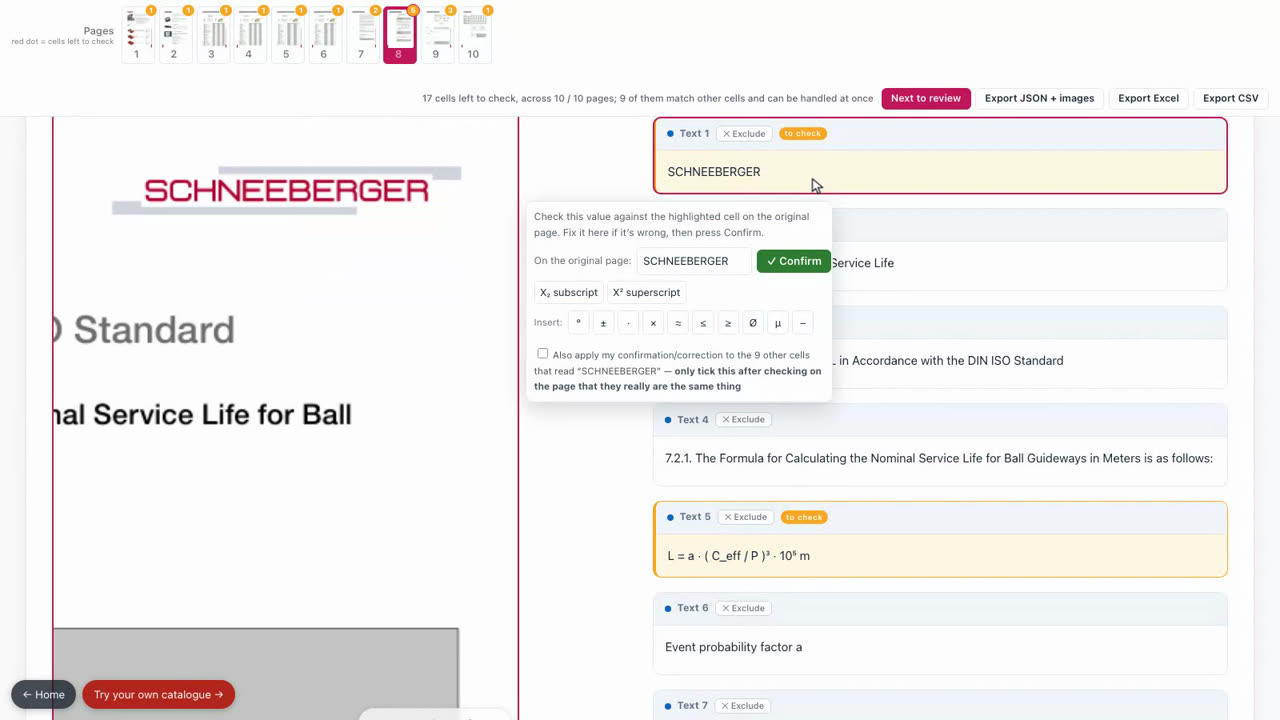
Every job ships with an interactive review page. Open it in your browser, and every flagged cell is one click away from settled — side-by-side with the original page. Work through the short flagged list yourself — most documents come out with only a handful.
Click a flagged cell and the original page zooms to the exact spot, with every reader's version listed.
The page is right? One click. It isn't? Type the fix — subscripts and engineering symbols included — and move on. A “next to review” button walks you through what's left.
Excel or CSV for spreadsheets — or one ZIP with the corrected JSON and every cropped image, enough to rebuild each page. Your edits stay in your browser; we never see them.
Check this value against the highlighted cell on the original page. Fix it here if it’s wrong, then press Confirm.
X₂ subscriptX² superscript °±×≤Ø
Other readings: 16.6
Catalogues carry pricing and unreleased products. We treat retention as a liability, not an asset.
Results, crops — and the OCR cache — are wiped 24 hours after completion. Nothing is kept to train on or resell.
DELETE /v1/parse/{id} removes a job immediately — you don’t have to wait for the window.
Once deleted, a resent document is processed — and billed — as a brand-new job. Keeping a shadow copy would be cheaper for us; we don’t.
$0.06 / delivered page
mode=batchConsensis is in beta — sign in with Google or email and you’re in. Questions, suggestions, volume and per-project quotes: [email protected] — no account needed to write to us.